CLIENT STORY
A good team was underperforming.
The problem was not the people.
How Mr Emeka Godson's company stopped losing its best people and built a culture where performance could actually happen.
Mr Emeka had built something real. His company had grown from three people in a co-working space at Trans Amadi to a twenty-two-person firm in old GRA Port Harcourt.
The company is blessed with corporate clients, a strong reputation, and a pipeline of talent that wanted to work there. From the outside, it looked like a success story. From the inside, Emeka was exhausted and quietly terrified.
He was the first person in every morning and often the last to leave. Almost every significant decision passed through him. Proposals went out late because they needed his review. Client escalations landed on his desk because his team was unsure how to handle objections.
He had hired people he believed in and was watching them underperform in ways he could not explain. Two of his best people had resigned in the same quarter, and both said something similar on their way out: they had not felt seen, and they had not felt they were growing.
22
person team across four departments
5
months engagement duration
0
resignations during our engagement
2
client testimonials towards close of our engagement
WHAT WE FOUND
We spent the first two weeks doing nothing but listening and observing. We sat in meetings, had conversations with people at every level, and reviewed how work was assigned, tracked, and evaluated. What we found was not a people problem. Mr Emeka had hired well. His team was capable and motivated. The problem was that the organization had grown faster than its systems, and nobody had stopped to redesign the conditions the team was working within.
01
Leadership Modeling
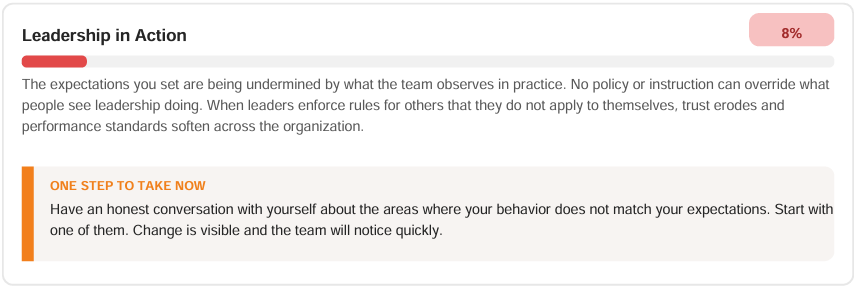
The team had quietly concluded that deadlines in Pinnacle were suggestions. Mr Emeka held others to standards he did not consistently apply to himself. Nobody said anything. But the gap was felt.
02
Role and Responsibility Clarity
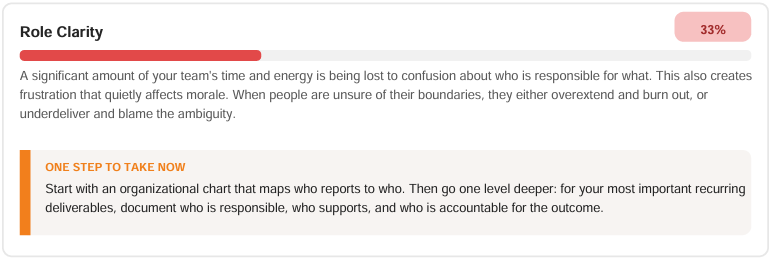
Proposals stalled for days because each team assumed the other had the next step. Handoffs existed in people's assumptions, not in any shared understanding of who owned what.
03
Invisible Growth
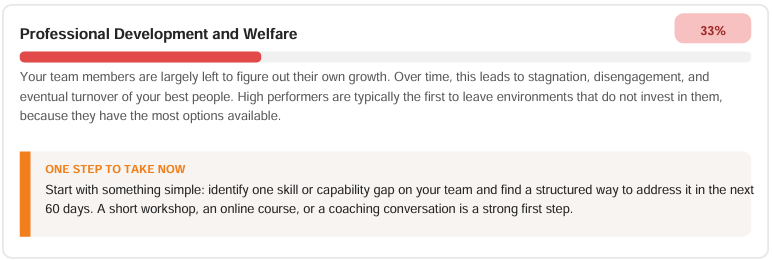
One of Mr Emeka's most valued team members was considering leaving. Not because the work was bad, but because two and a half years in, no one had ever asked where she wanted to go.
04
Recognition Gap
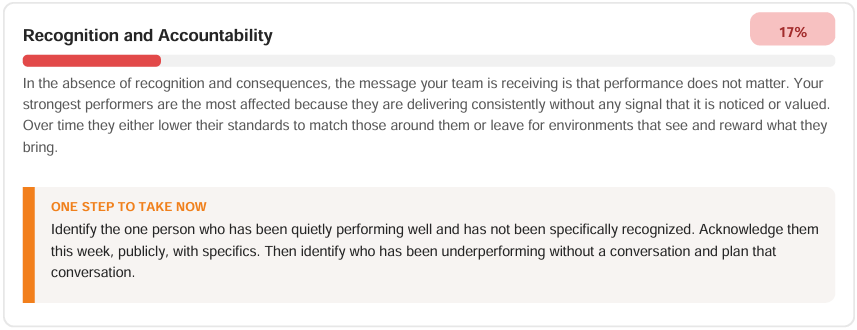
The analyst who stayed up overnight to turn a proposal around received the same response as the one who had missed three deadlines in a row. Performance had become emotionally invisible.
SNAPSHOTS OF PERFORMANCE DIAGNOSTIC RESULT
WHAT CHANGED
The most important conversation we had with Mr Emeka was not about his team. It was about him. We showed him how the culture he was frustrated by was, in large part, a reflection of what the team saw from him.
Mr Emeka expected his team to meet deadlines he had communicated. But when he committed to review a document by end of day and it slipped to the following morning, or when he told a client he would get back to them within forty-eight hours and took four days, the team noticed. Nobody said anything. But the unspoken conclusion was that timelines in the company were more like suggestions than commitments. If the standard did not apply to the founder, it was unclear why it should apply to anyone else.
He sat with that for a long time. Then he said: “I have been asking for a standard I was not keeping myself.” That moment of recognition was the beginning of everything else.
There were job descriptions. But job descriptions are written for hiring, not for daily execution. A proposal would be ninety percent done and sit untouched for two days because the person who thought it was being finalized was waiting for the person who thought it had already been signed off. A follow-up call that three people believed one of the others had made would never happen at all.
We facilitated a series of working sessions, not training sessions, not lectures, but structured conversations in which each team sat down together and mapped out the specific moments where their work touched someone else’s. Who handed what to whom. Who made the call when something was unclear. Who was the final name on every key deliverable before it left the building.
Within a month of implementing it, the number of internal escalations reaching Mr Emeka dropped significantly. People were resolving handoff questions themselves because they finally had a shared map of who owned what.
We helped Mr Emeka engage the career conversations he had never gotten around to, starting with the team member who had been quietly considering her exit. We introduced something simple but structured.
Career pathway conversations, not annual reviews, but direct one-on-one discussions with each team member focused entirely on where they were and where they wanted to go. What did they want to be able to do in a year that they could not do today? What was getting in their way? What could the company provide? The team member stayed, and she’s now being considered for promotion as at the time of publishing this.
Good performance was noticed in the sense that Mr Emeka appreciated it, but rarely named and almost never made visible.
A junior analyst who had turned around a research brief in twelve hours overnight so a proposal could go out on time had received a thank you that came and went in a sentence.
The analyst who had been delivering late, with work that needed significant correction every time, had also received no particular response because those conversations were uncomfortable and Mr Emeka had been deferring them.
We designed a recognition practice grounded in one principle: that good work should be named specifically, publicly, and in the moment, not stored up for a quarter-end or year-end review that most people stop believing in.
We also helped him have two of the performance conversations he had been avoiding, structured and professional conversations grounded in specific observations rather than general impressions, with clear expectations and defined timelines for improvement.
Both were uncomfortable. One produced a real turnaround. The other led to a mutual decision that the fit was not right. In both cases, the team watched. And what they saw was a leader who took performance seriously in both directions.
FINALLY
By the time we concluded our engagement
Five months after that first call, the organization was operating differently in ways that were visible and measurable.
- Proposals were going out on time.
- Internal escalations to Mr Emeka had reduced, giving him back meaningful hours each week.
- The research team doubled its output capacity. Not by working longer hours, but by removing ambiguity around roles and priorities.
- Adanna will be promoted and will now manage two junior researchers.
- Two positive client testimonials came in — something they rarely received before.
- The two resignations that triggered the engagement were the last ones recorded during the entire period.
When we asked Emeka at the end of the engagement what surprised him most, it wasn’t any single intervention. It was realizing how much of what the team was doing and not doing — traced back to the environment he had created without fully knowing it.
FIND OUT WHERE THE UNDERPERFORMANCE IS IN YOUR FIRM
For Mr Emeka's Firm...
The delays, the gaps, the low morale, none of them was primarily a talent problem. It was an environment problem. A condition problem. And conditions are entirely within a leader’s power to change.